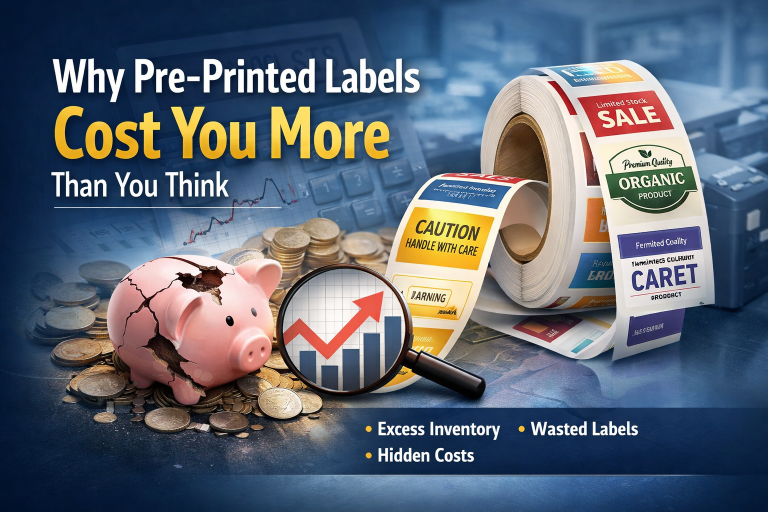
Why Pre-Printed Labels Cost You More Than You Think
Pre-printed labels may seem convenient at first, but they often come with hidden costs that can quickly add up. Businesses frequently need to order large quantities to keep unit prices low, which can lead to surplus stock sitting unused on shelves. When product details change, regulations update, or branding evolves, those unused labels quickly become obsolete — resulting in wasted materials and unnecessary reprint costs.
Relying solely on pre-printed labels can also slow down operations, as companies must wait for new label orders before updating products or launching changes. Over time, these limitations can drain budgets, reduce flexibility, and make it harder for businesses to respond quickly to market or regulatory demands.
Click Here To Read More
The Hidden Cost of Pre-Printed Labels
At first glance, pre-printed labels often seem like the cheaper option. Ordering labels in bulk usually reduces the price per label, which can make it feel like you are saving money.
However, many small and medium-sized businesses eventually discover that the real costs appear after the labels are delivered. Changes in products, regulations, or branding can quickly make large quantities of labels unusable.
The Hidden Costs Businesses Often Overlook
Wasted Label Stock
One of the biggest hidden costs of pre-printed labels is wasted inventory.
Products change more often than expected. Ingredients may be adjusted, formulas improved, warnings updated, or regulations revised. Even small packaging changes can require a new label.
When thousands of labels have already been printed, any unused stock may need to be discarded. This results in wasted labels, wasted materials, and unnecessary printing costs.
Outdated Branding
Brands naturally evolve over time. Logos are refreshed, colours are refined, and messaging improves as companies grow.
With pre-printed labels, businesses are often forced to continue using outdated designs until existing stock runs out. This can lead to inconsistent packaging and products that appear outdated on the shelf.
Consistent, modern branding plays an important role in how customers perceive a product.
Minimum Order Quantity Challenges
Many label suppliers require minimum order quantities. Businesses may only need a few hundred or a thousand labels but are required to order several thousand to meet the supplier’s minimum.
This leads to over-ordering and ties up valuable cash in unused inventory that may never be used.
Storage and Version Management
Large quantities of labels also require storage space. When multiple products, flavours, sizes, or languages are involved, managing label inventory can quickly become complicated.
Old and new versions may become mixed together, increasing the risk that incorrect labels are applied to products. These mistakes can create operational delays and damage brand credibility.
Slow Response to Product Changes
Pre-printed labels can also slow down a business when updates are required.
If product information needs to change, companies must wait for new labels to be printed and delivered. This can delay product launches, packaging updates, or regulatory adjustments.
In fast-moving markets, the ability to respond quickly is a significant advantage.
Why On-Demand Colour Label Printing Is Different
On-demand colour label printing allows businesses to print labels only when they are needed, using the most current product and branding information.
Instead of ordering thousands of labels in advance, companies can print the exact quantity required for current production.
This provides several advantages:
Reduced label waste
Immediate updates when information changes
Improved cash flow by avoiding large upfront orders
Less storage space required for label inventory
Faster response to product or market changes
Businesses can print labels today, update them tomorrow, and remain fully in control of their packaging information.
A Simple Example
Imagine a company that sells three flavours of a product and orders 5,000 labels for each flavour.
If an ingredient changes, a claim must be removed, or a warning needs updating, thousands of labels may instantly become unusable.
What initially appeared to be a cost-effective bulk order can quickly turn into a significant expense.
Final Thought
Pre-printed labels may appear economical at first, but the hidden costs often include wasted stock, slower updates, storage complications, and tied-up cash.
On-demand colour label printing offers a more flexible approach. By printing labels only when they are needed, businesses gain better control over their packaging, reduce waste, and respond more quickly to change.
Need Advice on the Right Printer for Your Business?
Every business has different requirements. The right on-demand colour label printer depends on your production volumes, label sizes, materials, and how often your labels need to change.
If you are unsure which solution would suit your operation best, contact Intellistor. Our label solution specialists will help you identify the right printer for your business and provide practical guidance based on your specific application.