Supplement & Health Product Labelling in South Africa: Why Version Control Matters More Than You Think
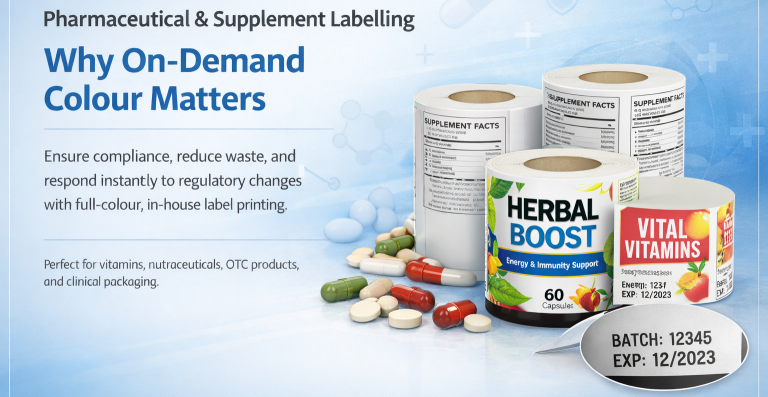
On-demand full-colour label printing gives pharmaceutical and supplement brands far greater flexibility and control over their labelling process. Instead of ordering large quantities of pre-printed labels that may become outdated, companies can print labels exactly when they are needed and update them instantly whenever regulations, formulations, or product information change.
This approach is especially valuable in highly regulated industries such as pharmaceuticals and dietary supplements, where labels must often include detailed ingredient information, dosage instructions, warnings, batch numbers, expiry dates, and supplier details. If any of this information changes, traditional pre-printed labels may need to be discarded and reordered, resulting in unnecessary cost, delays, and wasted inventory.
Click Here To Read More
Supplement Labelling Compliance in South Africa
If you manufacture or sell supplements, vitamins, herbal products, protein powders, or other health-related products in South Africa, your labels must comply with specific safety and labelling requirements.
These labels are essential for ensuring that consumers receive clear and accurate information about the product they are using.
A compliant supplement label typically includes:
Ingredient lists
Dosage instructions
Warnings and contraindications
Usage directions
Batch or lot numbers
Best-before or expiry dates
Supplier or manufacturer details
Claims and regulatory disclaimers
For many small and growing supplement brands, the challenge is not understanding what needs to appear on the label. The real difficulty is keeping labels accurate as formulations, regulations, and product details change.
Why Supplement Labels Change So Often
Health and wellness products evolve constantly.
Formulas are improved.
Dosages are adjusted.
New ingredients are added.
Claims may need to be revised or removed.
Warnings and regulatory wording can change.
Export markets often require different information.
Each of these changes typically requires an updated label.
For businesses using pre-printed labels, frequent changes can quickly become expensive and difficult to manage.
The Hidden Risks of Pre-Printed Labels
Ordering large quantities of labels in advance may seem cost-effective, but it can create several problems.
Wasted Labels
Even a small change—such as a dosage adjustment or ingredient update—can make existing labels unusable, resulting in wasted inventory and additional printing costs.
Compliance Risks
Some businesses continue using outdated labels to avoid waste. This can lead to:
Incorrect dosage instructions
Missing or outdated warnings
Incorrect ingredient information
Non-compliant claims
In the supplement industry, these errors can lead to regulatory issues, product recalls, and reputational damage.
Slower Product Development
When labels must be ordered in large quantities, businesses often hesitate to update products, test new formulations, or launch small product runs because label changes feel too costly.
Why On-Demand Colour Label Printing Helps
On-demand colour label printing allows businesses to print labels only when they are needed, using the most up-to-date information.
Instead of ordering thousands of labels in advance, companies can print smaller quantities as production requires.
This provides several important benefits:
Better version control – label updates can be implemented immediately
Reduced label waste – no unused inventory
Faster product updates – new formulations or warnings can be added quickly
Flexible production – ideal for small batches or multiple product variations
It also makes it easier to produce different label versions for different markets, helping businesses stay compliant when exporting products.
Final Thought
Supplement labelling is constantly evolving as products, regulations, and consumer expectations change. Businesses need a labelling process that can adapt just as quickly.
On-demand colour label printing not only improves the quality of your labels—it also helps supplement manufacturers maintain compliance, reduce waste, and respond quickly to changes.